
Before you start
You need one real task and access to two assistants, and free versions are fine. Pick something you do every week, such as summarizing a report, drafting a reply or cleaning up a table. Every fact below was read on the vendors' own pages on 4 November 2026. Lineups move on, and Microsoft's page says its model options update as new models become available.
Pick a model in five steps
- Write the task in one sentence and list what goes in: text only, a file, an image, a spreadsheet or a voice conversation.
- Note where the material lives. Microsoft describes Copilot inside Word, Excel, PowerPoint, Outlook and Teams, and Google's Gemini help says the links beside a response can include Workspace documents and emails once you connect Workspace. A file that already sits in one of those suites points you to its assistant.
- Choose the speed tier. Use the fast option for routine requests and the deeper-thinking option for multi-step problems. Microsoft's model selector calls them Quick response and Think deeper, with Auto as the default.
- Open a new chat in two assistants and send the identical prompt and file. Do not edit the prompt between them.
- Score both replies on a short checklist you wrote first: correct facts, the format you asked for, the tone and how much fixing you need. Keep the assistant that needed less fixing, and save the prompt that worked.
Fast models and reasoning models
OpenAI's prompting guide draws the line most clearly. Reasoning models generate an internal chain of thought to analyze the prompt, excel at complex tasks and multi-step planning, and are generally slower and more expensive than GPT models. GPT models are fast, cost-efficient and highly intelligent, but they do better with explicit instructions.
Anthropic's models overview labels its four current models by speed, from Haiku as the fastest to Fable as the slower one built for demanding reasoning. For developers, its choosing guide adds that tuning the effort setting is often a better lever than switching models. The table shows how each vendor words the same split.
Every flagship in that table is younger than ten weeks. Anthropic, OpenAI and Google shipped them between 1 September and 26 October 2026, by their own release notes and changelogs, so a ranking you read in the spring compares models that have since been replaced.
Claude Fable 5.1
Anthropic's slower, deeper model for long agent work, knowledge work and research.
Source: Anthropic: Claude Platform release notes (read November 5, 2026)
Gemini 3.8 Flash
Google's newest Flash model became generally available.
Source: Google AI Studio: Changelog (read November 5, 2026)
GPT-6 Astra
OpenAI's most capable model, for the hardest end-to-end work.
Source: OpenAI: API changelog (read November 5, 2026)
Claude Opus 5.5
For long-running agentic coding and knowledge work.
Source: Anthropic: Claude Platform release notes (read November 5, 2026)
GPT-6 Luna and GPT-6 Sol
Luna is OpenAI's efficient model for focused, high-volume tasks.
Source: OpenAI: API changelog (read November 5, 2026)
Claude Sonnet 5.5
The fast middle model in Anthropic's line.
Source: Anthropic: Claude Platform release notes (read November 5, 2026)
Claude Haiku 5.5
Tuned for high-volume work where response time matters.
Source: Anthropic: Claude Platform release notes (read November 5, 2026)
Gemini 4 Argon
Google's flagship reasoning model became generally available.
Source: Google AI Studio: Changelog (read November 5, 2026)
GPT-6.1 Terra
A fast OpenAI model for visual reasoning, computer use and natural writing.
Source: OpenAI: API changelog (read November 5, 2026)
| Vendor | Quick and routine | Deeper thinking | Source |
|---|---|---|---|
| Anthropic | Claude Haiku 5.5 is the fastest, and Sonnet 5.5 is fast | Claude Fable 5.1 is for demanding reasoning, and Opus 5.5 is for long-running agentic coding and knowledge work | Anthropic models overview |
| OpenAI | GPT-6 Luna, "our most efficient model for focused, high-volume tasks" | GPT-6 Astra, "our most capable model for the most demanding work" | OpenAI models page |
| Gemini 3.6 Flash, listed as the previous-generation Flash, balances speed and multimodal capabilities | Gemini 4 Argon is the flagship reasoning model | Google AI Studio | |
| Microsoft | Quick response | Think deeper, for complex or open-ended questions | Microsoft Copilot overview |
Files, images and voice
The model pages list what each vendor's models take in and give back. App features can differ from those lists, so confirm a file type in the app itself before you build a routine on it.
| Claude | OpenAI models | Gemini | |
|---|---|---|---|
| Image input | Yes | Yes | Listed as a modality |
| Audio, video or PDF | Not stated on the page | Separate speech and transcription models | Listed as modalities of Gemini 4 Argon |
| Makes images | Text output on the page | yes, GPT-Image-2.5 models | yes, Nano Banana models |
| Voice conversation | Not stated on the page | yes, GPT-Live 1 and Realtime models | yes, Live models |
Sources: Anthropic models overview (read November 4, 2026), OpenAI models page (read November 4, 2026), Google AI Studio models page (read November 4, 2026)
Free and paid tiers
Plans change often, so this section names tiers the way the vendors' pages did that day and leaves prices out.
- Anthropic's plan page lists Free, Pro, Max, Ultra, Team and Enterprise. Free names Sonnet and Haiku with limited usage, Pro adds Opus, and Fable comes through usage credits on Pro and is included up to a share of the weekly limit on Max.
- Google's AI plans page lists Google AI Plus, Pro and Ultra, with the Gemini 4 Argon model named on Pro and Ultra and usage limits that rise at each step.
- Microsoft's overview separates Copilot Chat (Basic), which uses web data only, from Microsoft 365 Copilot (Basic) and (Premium). Premium adds priority access and pulls in your work data without manual uploads.
- OpenAI's help center, where the ChatGPT app's own plans and model picker are described, did not open for us on 4 November 2026. This lesson leaves ChatGPT's tiers out, so read its plan page yourself.
We would run the five-step test on free tiers first. A limit you hit on a real task is better evidence for paying than a feature list.
How Andrej Karpathy and Ethan Mollick pick a model for each question
Most questions need only the fast model. The skill is spotting the ones that don't. Andrej Karpathy, an AI researcher and educator who was a founding member of OpenAI, shared his own routine on X on 2 June 2025. About 40% of what he asked went to the fast everyday model, simple things like which foods are high in fiber. Another 40% went to the reasoning model: anything hard or important enough to wait for, such as a tax question. Coding and long research runs took about 10% each.
Every model his post names has been replaced since. The split still works as step 3 of the five steps: sort each request by what a shallow answer would cost you, then pick the tier. He also moved between five assistants depending on the task, which is the side-by-side test this lesson asks for.
Leaving the choice to the app has a catch. Ethan Mollick, a Wharton professor who studies AI, described it on X on 9 August 2025, soon after GPT-5 arrived. Asking for "GPT-5" could land you on one of the best models available or one of the worst, and it might switch within one conversation. The way out was paying for model switching and knowing to pick GPT-5 Thinking or Pro. Copilot's Auto setting is the same kind of router, so when an answer matters, pick the deeper option yourself.
In practice my use is more complicated because I like to bounce between all of ChatGPT, Claude, Gemini, Grok and Perplexity depending on the task and out of research interest.
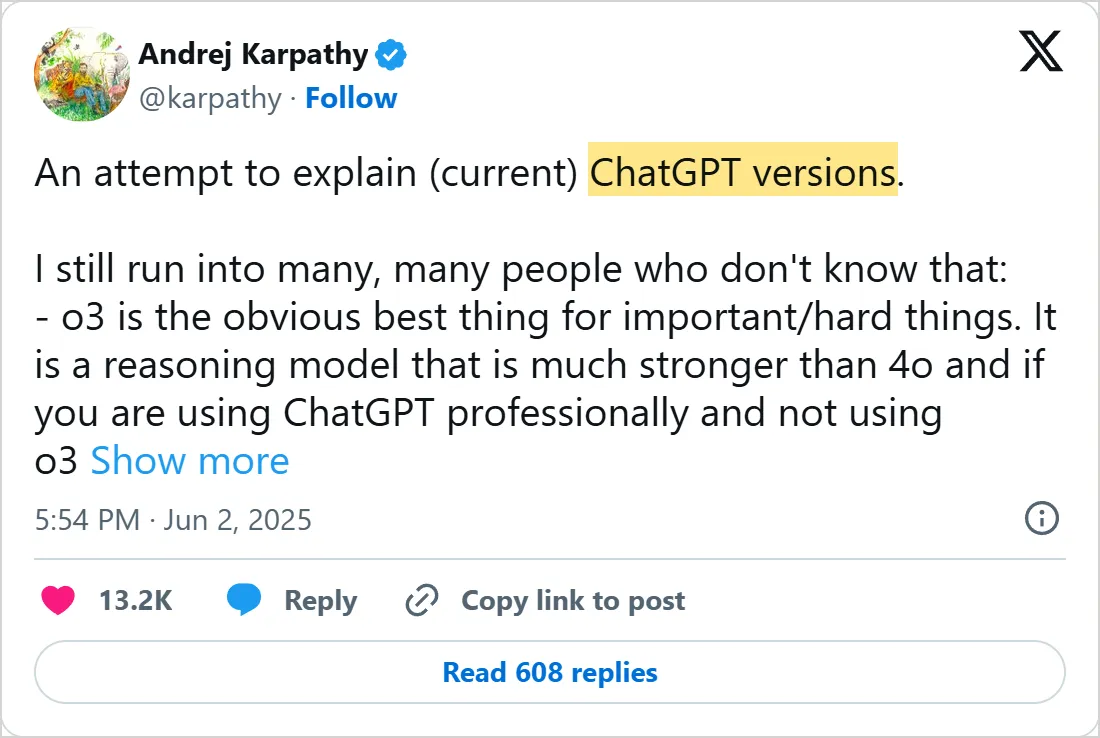
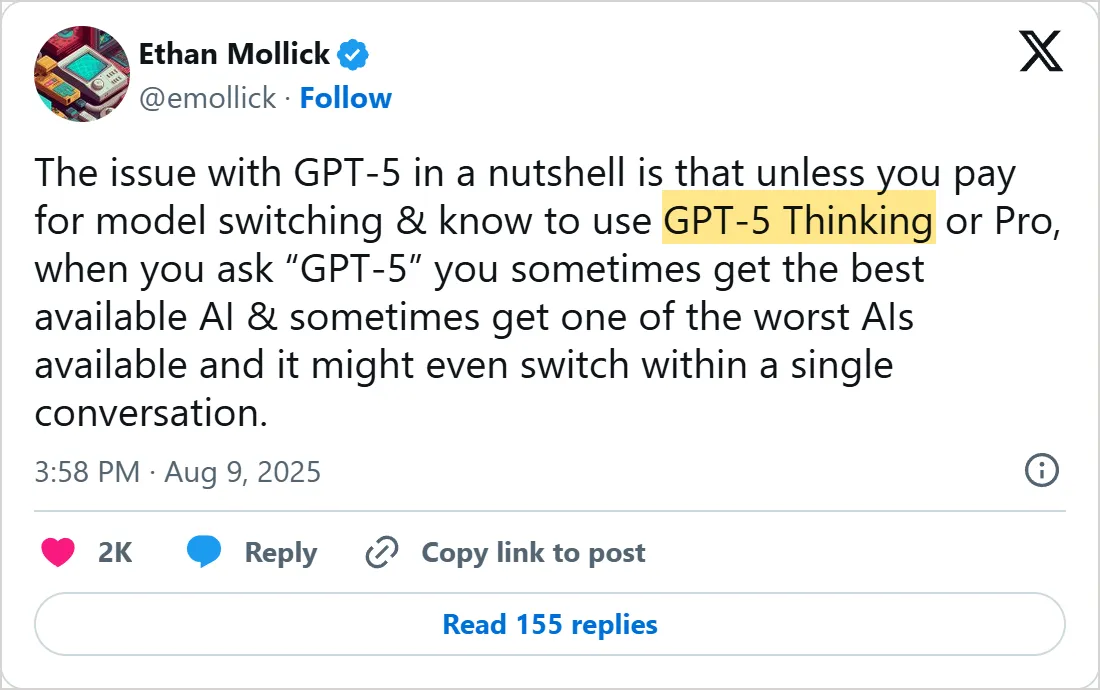

Screenshots of X's own embeds of the posts, taken on 5 November 2026, with the time in UTC. X cuts Karpathy's post short with Show more. Select one to open the post on X.
Common mistakes
- Choosing from a ranking list. Lineups turn over fast: Google's own models page already lists deprecated and shut-down models next to the current ones.
- Using the deepest-thinking option for every message. OpenAI's guide calls reasoning models generally slower and more expensive, and a quick model fits routine work.
- Judging on one prompt. Anthropic's guide for developers calls a good evaluation set the most important step, and for you that means three real tasks, not one.
- Sending a file type the assistant does not list. Check the vendor's page for what it accepts first.
Try it yourself
- Run the five steps on one task from your week and write your verdict in two lines.
- Repeat with a harder task, switch to the deeper-thinking option and note how much longer it took and whether the reply improved.
- Open the model selector in the assistant you use most and write down the names it shows today. Check them again in a month.
Next: when the model gets it wrong
Choosing well lowers the number of mistakes and removes none of them. The next lesson, AI hallucinations, shows why a fluent answer can be false and how to check one.
If you want to know how much text a model can read at once, the context window lesson explains it, and the lesson on how models work covers why each model has a cutoff date.
Check yourself
What is the best first question when you choose between assistants?
Show answer
D. What is my task, and where do my files and apps live? The task and where the material lives decide which assistant can reach it and which model tier fits.
How does OpenAI's guide describe reasoning models next to GPT models?
Show answer
C. Generally slower and more expensive, and better at multi-step planning The guide says reasoning models excel at complex tasks and multi-step planning and are generally slower and more expensive than GPT models.
In Microsoft's Copilot model selector, which option fits a complex or open-ended question?
Show answer
A. Think deeper Think deeper uses a reasoning model for complex questions, while Quick response favors speed for routine ones and Auto lets Copilot decide.
You want to know whether a free tier is enough. What is the sturdiest way to find out?
Show answer
B. Run your real task on two free tiers and see whether a limit stops you A limit you hit on a real task is better evidence for paying than a feature list, and the same test compares two assistants fairly.
Frequently asked questions
Which AI is best for coding?
All three vendors name a top model for it. Anthropic's choosing guide lists its Opus model for complex agentic coding and its Sonnet model for everyday coding. OpenAI recommends GPT-6 Astra for complex reasoning and coding. Google describes Gemini 3.8 Flash as built for long-horizon software engineering. Run your own code through two of them.
Is Copilot the same as ChatGPT?
No. Copilot is a Microsoft product, and Microsoft's application card says it uses models from Microsoft, Anthropic and OpenAI. That lets Microsoft match each feature to a model for speed or creativity.
Do I need to pay for an AI assistant?
Not to start. Anthropic's plan page lists a Free plan with Sonnet and Haiku and limited usage, and Microsoft describes a Copilot Chat (Basic) experience included with eligible Microsoft 365 licenses. Pay when a limit blocks real work.
What does a reasoning model do differently?
It works through the problem in an internal chain of thought before answering. OpenAI's guide compares it to a senior co-worker you can give a goal, while a GPT model is like a junior co-worker who needs explicit instructions to produce a specific output.
Can an assistant pick the model for me?
Sometimes. Microsoft says Copilot defaults to Auto, a real-time router that adjusts the underlying model to your prompt, and you can choose Quick response or Think deeper yourself.
How often do model names change?
Often. Anthropic's models page lists current models beside a row of legacy ones. Google's page marks several as deprecated, with Gemini 2.5 Flash and 2.5 Pro scheduled to route to newer models on December 1, 2026. Recheck before you commit to one.
Sources
- Anthropic: Models overview https://platform.claude.com/docs/en/models/overview
- Anthropic: Choosing the right model https://platform.claude.com/docs/en/about-claude/models/choosing-a-model
- Anthropic: Claude models explained https://claude.com/resources/articles/claude-models-explained-choosing-the-best-model-for-your-use-case
- Anthropic: Claude plans https://claude.com/pricing
- OpenAI: Models https://developers.openai.com/api/docs/models
- OpenAI: Prompt engineering https://developers.openai.com/api/docs/guides/prompt-engineering
- Google AI Studio: Gemini models https://aistudio.google.com/docs/models
- Google: Google AI plans https://one.google.com/about/google-ai-plans/
- Google Gemini Apps Help: View related sources https://support.google.com/gemini/answer/14143489
- Microsoft Learn: What is Microsoft Copilot? https://learn.microsoft.com/en-us/copilot/plan/copilot-overview
- Microsoft Learn: Application card, Microsoft Copilot (for organizations) https://learn.microsoft.com/en-us/copilot/plan/microsoft-365-copilot-application-card
- Anthropic: Claude Platform release notes https://platform.claude.com/docs/en/release-notes/overview
- OpenAI: API changelog https://developers.openai.com/api/docs/changelog
- Google AI Studio: Changelog https://aistudio.google.com/docs/changelog
- Andrej Karpathy on X, 2 June 2025 https://x.com/karpathy/status/1929597620969951434
- Ethan Mollick on X, 9 August 2025 https://x.com/emollick/status/1954210778321465634
- YouTube: Andrej Karpathy, How I use LLMs https://www.youtube.com/watch?v=EWvNQjAaOHw